By Ophelia Anderson
In Mother Mary, Anne Hathaway doesn’t just play a pop star – she dissects one. What emerges is less a performance than an excavation: of fame, of femininity, of the strange, glittering violence required to remain visible in a world that consumes women as spectacle.
At 43, Hathaway finds herself in a career chapter defined not by reinvention, but by refinement. There is a precision now – an emotional calibration – that feels worlds away from the ingénue of The Princess Diaries or even the scrappy assistant of The Devil Wears Prada. And yet, in Mother Mary, those earlier selves echo faintly, refracted through the fractured psyche of a woman who has lived too long under the gaze.
Directed by David Lowery, the film follows Mary, a global pop icon clawing her way toward a comeback, who reconnects with her former collaborator and possible lover, Sam (Michaela Coel). Their reunion – sparked by something as deceptively simple as a dress – unspools into a fever dream of memory, desire, and artistic co-dependency.
Becoming Mary: Pop as Performance, Performance as Survival
Hathaway has long flirted with musical roles – her Oscar-winning turn in Les Misérables remains a career high – but Mother Mary demands something altogether more elusive. This is not musical theatre; it is pop, that most manufactured yet emotionally immediate of art forms.
To prepare, Hathaway immersed herself in the mechanics of modern superstardom. She studied Beyoncé with almost anthropological focus, spending two years shaping Mary’s voice and physicality. What struck her was not just vocal control, but restraint – the “stillness” that allows emotion to resonate.
There is something telling in Hathaway’s admission that she does not consider herself a “natural singer.” The vulnerability of that statement bleeds into the performance. Mary is not effortless; she is constructed, disciplined, perpetually on the brink of collapse. In one particularly gruelling scene, the emotional toll became overwhelming – so much so that Hathaway reportedly warned her co-star: “I think what’s going to come out of me will hurt you.”
This is the paradox at the heart of Mother Mary: the idea that pop – so often dismissed as surface – is, in fact, an act of profound emotional exposure.
Fashion as Language
If music is Mary’s voice, fashion is her armour.
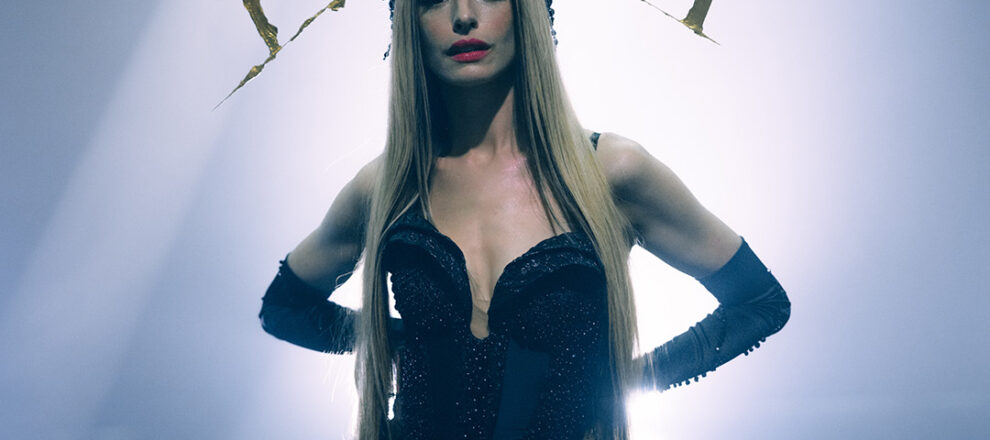
Costume designer Bina Daigeler constructs a wardrobe that charts Mary’s psychological arc with almost operatic intensity. Crystal-studded bodysuits, halo-like headpieces, and sheer, sculptural gowns draw on the iconography of Madonna, Taylor Swift, and Dua Lipa, while pushing into something stranger, more symbolic.
In the film’s climax, Mary appears in a dramatic red organza creation by Iris van Herpen – a look that evokes both martyrdom and rebirth. It is less costume than statement: a shedding of skin.
Off-screen, Hathaway has embraced this aesthetic with gusto. During the film’s promotional tour, she has leaned into sheer fabrics, sculptural silhouettes, and unapologetic sensuality – channelling everything from Lady Gaga to Swift’s Reputation era.
It is a clever blurring of lines: the actress becomes the character becomes the icon.
The Chemistry of Collapse
Central to the film’s emotional core is Hathaway’s dynamic with Coel – a relationship that defies easy categorisation. It is creative, romantic, antagonistic; at times, it feels almost mythic.
Coel has described their connection as something deeper than conventional love, “greater than a love I’ve ever known with a stranger.” That intensity translates onscreen into a push-pull dynamic that borders on possession. Each woman reflects and distorts the other, like mirrors angled just slightly off.
Lowery’s direction leans into this ambiguity, framing their relationship through surreal imagery and gothic flourishes. Critics have described the film as a “visually arresting” pop melodrama, even if its narrative occasionally dissolves into abstraction.
But perhaps coherence is beside the point. Mother Mary is less interested in telling a story than in evoking a state of being the disorientation of fame, the intimacy of collaboration, the terror of being truly seen.
The Sound of Reinvention
The film’s soundtrack – featuring contributions from Charli XCX, FKA Twigs and Jack Antonoff – is integral to its atmosphere.
These are not traditional musical numbers. They function more like emotional ruptures, moments where language fails and music takes over. Each track feels curated to reflect Mary’s interiority – her longing, her rage, her hunger for transcendence.
Hathaway reportedly worked closely with these artists to understand not just how a pop star sounds, but how she thinks: the rhythms of touring, the pressures of reinvention, the constant negotiation between authenticity and performance.
A Brief Return to Runway
It is impossible to discuss Hathaway in 2026 without acknowledging the cultural gravity of The Devil Wears Prada 2, in which she reprises her role as Andy Sachs – now navigating a dramatically altered media landscape.
If Mother Mary is about the cost of visibility, Prada 2 appears to explore its evolution. Andy, once the wide-eyed outsider, returns as a seasoned insider, her ambition tempered by experience. Hathaway herself has spoken about entering a new phase of life – one defined not by “balance,” but by “harmony.”
It’s a subtle but significant shift. Where Mary is all intensity and fragmentation, Andy promises something steadier, more grounded. Together, the roles form a kind of diptych: two women negotiating identity within systems that demand transformation.
The Hathaway Moment
There is a temptation, when writing about Hathaway, to frame her current success as a comeback. It isn’t. It is something quieter, more deliberate: a recalibration.
In Mother Mary, she strips away the easy charm that once defined her screen persona, replacing it with something sharper, stranger and more unsettling. It is, arguably, one of the boldest choices of her career.
And yet, beneath the spectacle – the couture, the music, the psychological intensity – there remains a recognisable core. Hathaway has always been an actress drawn to emotional truth, even when wrapped in fantasy.
Mary may be a pop icon, but she is also something more universal: a woman trying, against impossible odds, to reconcile who she is with who the world demands she be.
In that sense, the film feels less like a departure than a culmination.
A star, after all, is not born. She is made- and remade, again and again, until what remains is something indelible.