By Ophelia Anderson
There are few children’s stories as deeply embedded in British – and by extension, South African – childhood as The Magic Faraway Tree. Long before algorithms curated entertainment and screens dominated attention spans, Enid Blyton offered something simpler: a tree, a handful of eccentric characters, and the idea that adventure could be discovered just beyond the back garden.
Now, more than eight decades later, that world arrives in cinemas on 27 March – not as a book passed from parent to child, but as a feature film tasked with doing something far more complex: translating nostalgia into relevance.
The question is not whether The Magic Faraway Tree is beloved. It is. The question is whether that kind of quiet, whimsical storytelling can still hold its own in a cinematic landscape defined by pace, spectacle and short attention spans.
The Weight of Memory
For many adults, Blyton’s work isn’t just literature – it’s emotional shorthand. The Faraway Tree exists in memory as much as it does on the page: a place of freedom, imagination and gentle chaos.
That emotional connection is both the film’s greatest strength and its biggest risk.
As one UK critic observed following early screenings:
“This isn’t just an adaptation – it’s an interpretation of how we remember childhood.”
And memory, as any parent knows, is selective. The slower pacing that once felt immersive may now feel restrained. The simplicity that once felt magical may risk being mistaken for slightness.
Yet, in resisting the urge to radically modernise the material, the filmmakers appear to have made a deliberate choice: to preserve tone over trend.
A Story About Disconnection – in a Distracted Age
The film’s premise has been gently updated for contemporary audiences. A modern family – Polly, Tim and their children Beth, Joe and Fran – are uprooted from a screen-saturated life and relocated to the countryside. No Wi-Fi. No digital distractions. Just space, silence, and eventually, discovery.
It’s a familiar narrative device, but one that lands differently in 2026 than it might have even a decade ago.
We are, after all, living through an era of increasing parental anxiety around screen time and shrinking attention spans. The idea of children rediscovering play, imagination and nature is no longer quaint – it’s aspirational.
A reviewer in The Guardian recently noted: “What once felt like fantasy now feels like commentary – a reminder of how far childhood has drifted from the physical world.”
The Faraway Tree, in this context, becomes more than a magical setting. It becomes a metaphor for something many families feel they’ve lost.
The Challenge of Pace
If there is a tension at the heart of The Magic Faraway Tree, it lies in pacing.
Modern family films often rely on relentless momentum – rapid dialogue, constant visual stimulation, and high-stakes conflict. Blyton’s world, by contrast, unfolds episodically. It lingers. It meanders.
Early reactions suggest the film leans into this structure rather than abandoning it. Each “land” at the top of the tree offers a contained adventure, more curious than climactic.
For younger children, particularly those under 10, this may prove refreshing – even soothing. But for older viewers accustomed to faster storytelling rhythms, it may require a recalibration of expectations.
As one reviewer put it: “It asks you to slow down – and whether that feels like a gift or a frustration will depend on what you bring into the cinema with you.”
Characters Over Spectacle
Where the film finds its footing is in its characters.
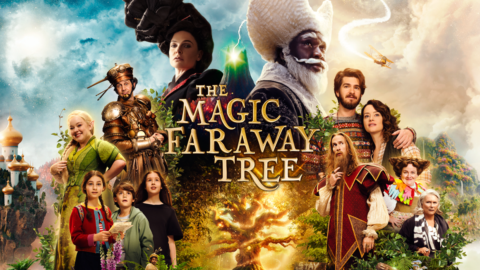
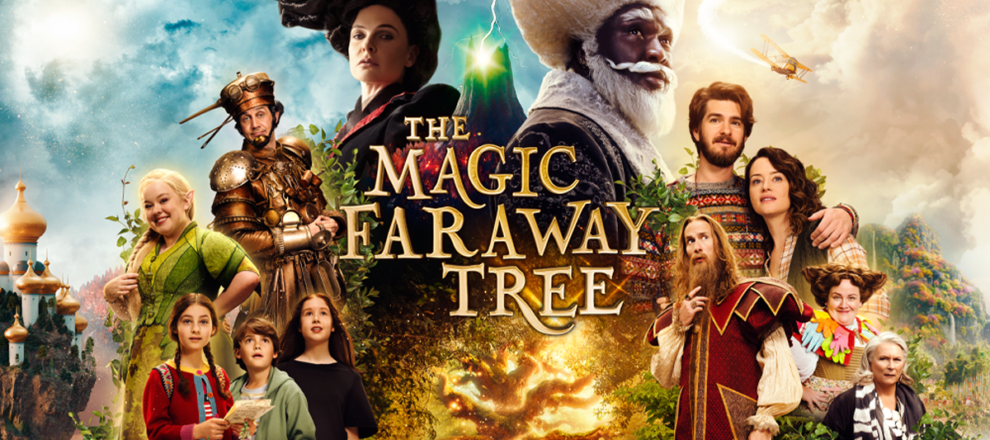
Moonface, Silky, Dame Washalot and the famously muddled Saucepan Man remain central to the experience – not as side attractions, but as the emotional anchors of the story.
In an era where many family films prioritise visual scale over character depth, this is a notable choice.
The humour, too, is less about punchlines and more about personality – gently absurd, occasionally chaotic, but rarely overwhelming. It’s the kind of humour that invites children in, rather than bombarding them. It’s a film that trusts children to engage, rather than demanding their attention. And that distinction may prove crucial.
Nostalgia vs Accessibility
For audiences unfamiliar with Blyton’s work, The Magic Faraway Tree enters the conversation without the cushion of nostalgia.
This raises a key question: does the film stand on its own?
Early indications suggest it largely does, though its emotional resonance is undeniably amplified for those who carry a personal connection to the source material. For new audiences, the appeal lies in its sense of discovery – the gradual unveiling of a world that feels handcrafted rather than engineered.
For returning audiences, the experience is more layered. It’s not just about what’s on screen, but what it evokes. As some of the first audiences reflect, “I’m not sure if I loved the film itself, or what it reminded me of – but perhaps that’s the point.”
A Different Kind of Family Film
What sets The Magic Faraway Tree apart is not what it does, but what it resists. It resists irony and cynicism and the need to constantly escalate. In doing so, it occupies a space that has become increasingly rare in mainstream cinema: earnest, intergenerational storytelling.
That may limit its appeal for some audiences, particularly those seeking high-energy entertainment. But it also positions the film as something different – perhaps even necessary.
In a local context, where cinema attendance has faced ongoing pressure, films that offer a genuine shared experience across age groups are increasingly valuable.
The Cinema Question
There is also the question of whether this is a “big screen” film in the traditional sense.
It lacks the spectacle of blockbuster franchises. Its stakes are emotional rather than epic. And yet, there is an argument to be made that this is precisely the kind of film that benefits from communal viewing. Children reacting together and parents recognising fragments of their own childhood. Families leaving the cinema with something to talk about – beyond visual effects.
In that sense, The Magic Faraway Tree may not demand the big screen, but it may quietly justify it.
The Verdict
The Magic Faraway Tree does not appear to be chasing trends. It is not trying to outpace or outshine its contemporaries. Instead, it is asking something far simpler – and perhaps more difficult. It is asking audiences to slow down, sit with a story and embrace a different rhythm.
To find magic in small moments rather than large spectacles. For some, that will feel like a welcome return and for others, it may feel like a relic of a different era.
But in a cultural landscape that rarely makes space for this kind of storytelling, its very existence feels notable. Whether it becomes a beloved family classic for a new generation – or remains primarily a nostalgic echo for those who remember – will be decided not by marketing, but by audiences themselves. Either way, when the lights go down on 27 March, the climb begins again. And for many, that may be reason enough.