By Ophelia Anderson
Long before it became a viral curiosity or the centrepiece of a modern horror film, the object now popularly known as the Aztec death whistle was part of a deeply symbolic ritual world where sound, breath and death were inseparable.
To contemporary ears, the whistle’s shrill, unsettling tone seems engineered to frighten. Videos online often describe it as producing a scream “like a dying human,” reinforcing a popular theory that Aztec warriors used massed whistles to terrify enemies on the battlefield. Yet archaeologists caution that this dramatic image says more about modern imagination than historical evidence.
The truth, as with much of Aztec ritual culture, is more complex – and far more interesting.
Discovery in a Sacred Context
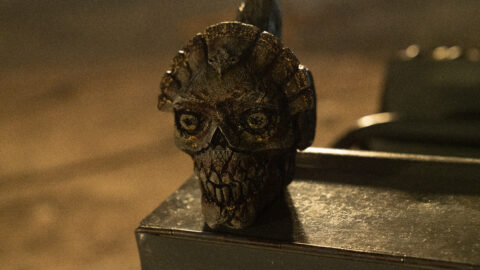
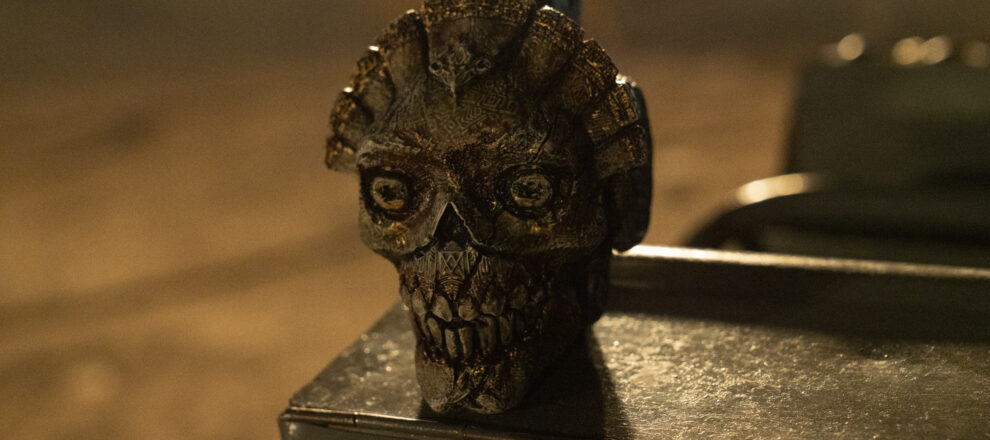
The best-documented Aztec death whistles were uncovered in the late 1990s during excavations at Tlatelolco, part of present-day Mexico City. Archaeologists discovered the remains of a young man believed to have been sacrificed in a ritual dedicated to Ehecatl-Quetzalcoatl, the god of wind. In the skeleton’s hands were two small ceramic objects shaped like skulls – whistles unlike any other instruments previously identified in Mesoamerican archaeology.
This context matters. The whistles were not found on a battlefield, nor among weaponry or military regalia. They were uncovered in a ceremonial space, in association with sacrifice, wind symbolism, and death imagery – elements central to Aztec cosmology.
The skull motif itself was not unusual. Skulls appeared frequently in Aztec art, architecture and ritual, representing not only death but also rebirth, fertility and the cyclical nature of existence. To the Aztecs, death was not an end but a transformation.
How the Whistle Works
Unlike conventional flutes or ocarinas, the death whistle is an aerophone with a complex internal chamber. When air is blown through it, the sound is disrupted and distorted, producing a rough, chaotic tone rather than a clean musical note.
Acoustic researchers classify the whistle as an “air-spring” instrument – meaning the sound is shaped by the interaction between airflow and the enclosed chamber, not by finger holes or reeds. This design allows for variability: depending on how hard it is blown, the whistle can sound breathy and wind-like or sharp and piercing.
Importantly, music archaeologist Arnd Adje Both, who studied original Aztec whistles, has noted that some of the most extreme “screaming” sounds heard today come from modern replicas, not necessarily from the original artefacts themselves. In controlled studies, the original whistles appear to have produced subtler, more wind-like noises when played at ritual volumes.
The Myth of Battlefield Terror
The idea that Aztec warriors blew hundreds of death whistles simultaneously to terrify their enemies is one of the most widespread – and least supported – theories.
No Spanish colonial accounts explicitly describe such a tactic. Nor do surviving Aztec codices depict massed whistle use in warfare. While Aztec armies certainly used sound – drums, conch shells and chants – there is no archaeological evidence linking death whistles to military formations.
Historians suggest this myth gained traction because it fits neatly into a familiar trope: the “fearsome” warrior culture using psychological terror as a weapon. It is a compelling story, but one that oversimplifies Aztec society and strips ritual objects of their deeper symbolic meaning.
Breath, Wind and the Soul
To understand the death whistle, one must understand breath.
In Aztec belief, breath (ehecatl) was life itself. Wind was not merely a natural phenomenon but a divine force that animated the world. Ehecatl-Quetzalcoatl, the wind god, was responsible for sweeping away the old to make room for the new – including clearing paths for the sun and guiding souls toward the afterlife.
The underworld, Mictlan, was not a place of punishment but a destination for most souls after death. Reaching it required a perilous journey through nine levels, often described as filled with violent winds and trials. Sound – especially breath-driven sound – was a powerful metaphor for this passage.
In this context, a whistle that mimics wind or chaotic breath may have functioned as a ritual tool representing the soul’s transition, the voice of the dead, or the presence of divine forces.
Sacrifice and Symbolism
Human sacrifice, while shocking to modern sensibilities, was a sacred act in Aztec religion. It was believed to sustain cosmic order and repay the gods for their own sacrifices in creating the world.
The presence of death whistles in sacrificial contexts suggests they may have been used during or after ritual acts, perhaps to invoke divine attention, accompany prayers, or symbolically release the breath of the victim. Some scholars have proposed that the whistle could represent the final exhalation – a sonic echo of life leaving the body.
This interpretation aligns with the whistles’ placement in the hands of the deceased, a deliberate positioning that implies ritual intent rather than incidental inclusion.
Why the Sound Still Disturbs Us
Modern psychological studies suggest that the death whistle’s sound triggers discomfort because it occupies an auditory space between recognizable categories. It resembles screaming, wind, animal distress and mechanical noise all at once – a kind of acoustic ambiguity that unsettles the human brain.
Researchers studying human responses to alarm calls note that sounds which lack clear origin or intention often provoke anxiety. This may explain why the whistle feels “unnatural” even though it is, quite literally, made by breath.
In other words, the whistle disturbs not because it was designed to terrorize, but because it mirrors sounds humans instinctively associate with danger and transition.
From Sacred Object to Pop Culture Icon
In recent decades, the Aztec death whistle has undergone a transformation. It has appeared in museum exhibits, experimental music performances, internet videos and, most recently, horror cinema.
This shift raises important questions about cultural reinterpretation. When ancient ritual objects are removed from their original context, they can easily be reshaped into symbols of fear rather than meaning. Scholars caution against allowing spectacle to overshadow scholarship.
Yet there is also value in renewed interest. The popularity of the whistle has drawn attention to Aztec cosmology, music archaeology and sound studies – fields that often receive little mainstream coverage.
Between History and Horror
Films like Whistle tap into the object’s ambiguity, not its historical certainty. And perhaps that is fitting. The Aztec death whistle resists simple explanation. It sits at the intersection of sound, ritual, death and breath – concepts that are universal, yet deeply culture-specific.
What we know is grounded in archaeology: where it was found, how it was made, what gods it was associated with. What we do not know – exactly how it was used, what it sounded like in ritual settings, how participants understood it emotionally – remains open to interpretation.
That gap between knowledge and mystery is where imagination rushes in.
A Sound That Refuses to Be Silenced
Centuries after the fall of the Aztec Empire, the death whistle continues to speak – not as a scream of terror, but as an echo of a worldview where sound carried spiritual weight and breath connected humans to gods.
Its power lies not in horror, but in resonance.
And perhaps that is why, when blown today, it still makes us uneasy: not because it predicts death, but because it reminds us how thin the line once was between the living world and the unseen.