By Ophelia Anderson
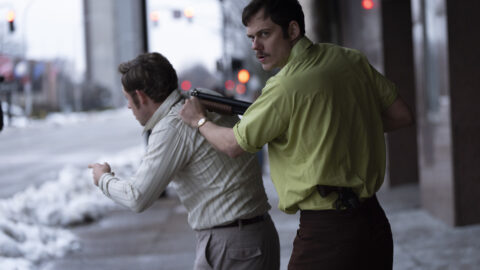
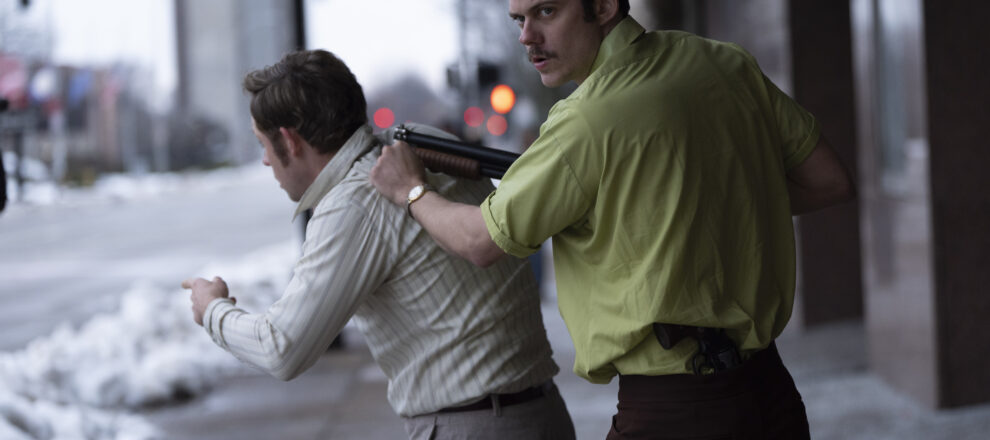
On the morning of 8 February 1977, a small, ordinary office in downtown Indianapolis became the stage for one of the strangest and most unsettling hostage situations the United States had ever seen. A man named Tony Kiritsis – neither a career criminal nor a political radical – walked into Meridian Mortgage Company, wired a sawn-off shotgun to the neck of its president’s son, and marched the man through the streets with a homemade dead man’s switch that meant any sudden movement, from him or anyone else, would trigger the gun.
Almost 50 years later, Dead Man’s Wire revisits that brittle moment in American history. It does so not with sensationalism, but with a kind of forensic curiosity: what happens when an ordinary citizen convinces himself that the only way to be heard is to become dangerous?
The film reconstructs the tense standoff between Tony (played with a raw unpredictability by Bill Skarsgård) and Richard Hall (Dacre Montgomery), the man at the business end of the weapon. Tony’s grievance – a land deal he believed had ruined him – was the kind of bureaucratic dispute that never trends, never goes viral, and never gets resolved quickly. But in 1977, for 63 hours, Tony turned his private despair into a national broadcast, demanding $5 million, legal immunity, and something much stranger: an apology.
This is the detail that lingers. Money and immunity are transactional; an apology is existential. It suggests a man who feels wronged not just financially, but spiritually – someone clawing for dignity in a system he believes has quietly shrugged him off.
The film captures that emotional volatility without romanticising it. Skarsgård plays Tony as someone oscillating between intelligence and instability, between wounded charm and volcanic rage. There’s no attempt to turn him into either a martyr or a monster. Instead, he is allowed to be what he was: a man unravelled by circumstance, conviction, and a sense of injustice that had curdled over years.
Opposite him, Montgomery’s Richard is not a cipher. The film gives him interiority – fear, yes, but also an unexpected compassion as the hours grind on. In a story dominated by spectacle, these human beats matter. They bring into focus the uncomfortable reality of hostage situations: most of the terror unfolds in the quiet moments, the long silences, the attempts to keep breathing steadily while someone else is losing control.
The presence of the media, however, is what gives Dead Man’s Wire its contemporary sting. Tony refuses to deal with police negotiators; he chooses instead to speak only to a respected newsman, Fred Temple (Colman Domingo). What follows is a strange, uneasy pas de deux between a hostage-taker and a journalist forced into a role that blurs the usual lines of professional distance.
Temple becomes Tony’s public translator – the voice narrating his grievances to a captivated nation. Crowds gather. Reporters swarm. The hostage scene morphs into a live drama, the kind of story that pulls a country into a collective holding of breath.
Watching it in 2026, it feels eerily familiar. We live in a world where the boundary between private anguish and public theatre is perilously thin. Where outrage is content. Where platforms amplify not nuance but noise. Dead Man’s Wire gives us the proto-version of a phenomenon we now live with daily: the person who, in desperation, forces themselves into the centre of the national conversation.
The film does not moralise about the media’s role, but it does pose the question: at what point does covering the news become participating in it? Domingo plays Temple with an understated weariness – a man who understands the stakes, and understands too that his presence may be pouring both water and petrol on the same fire.
The supporting cast deepens the tension. Al Pacino appears as M.L. Hall, the mortgage company president, with the kind of measured restraint that only an actor of his calibre can bring. In a story built on simmering anxiety, his scenes provide rare moments of stillness, forcing viewers to consider the structures and systems Tony believed had crushed him.
But the film’s real power lies not in its recreation of a historical case, but in its refusal to tidy it up. It doesn’t offer neat ideological readings. It doesn’t transform Tony into a symbol of rage-against-the-machine populism. Instead, it holds the messy truth: that he was both sympathetic and dangerous, articulate and unravelling, the product of real grievances and deeply flawed responses.
In that sense, Dead Man’s Wire feels less like a true-crime thriller and more like a study in pressure – the slow-building, everyday kind that quietly accumulates around ordinary people until something breaks. It’s about the looped conversations people have with themselves when they feel powerless, and the terrible decisions that sometimes follow.
South African viewers may see echoes of their own context: frustrations with bureaucracy, the feeling of being dismissed by institutions, the simmering anger that comes from navigating systems that often seem disinterested in ordinary lives. While the film is set in 1970s America, its emotional landscape transcends time and geography.
Stylistically, the film uses claustrophobia as a narrative engine. Close-ups, narrow hallways, crowded newsrooms – everything feels too close, too tight, as if the viewer has been pulled into Tony’s unraveling mental space. But it is the quieter scenes that linger afterwards: the pauses, the hesitations, the moments where Tony seems to frighten even himself.
By the end, the film leaves audiences not with answers, but with reflections. How thin is the line between grievance and obsession? Between desperation and violence? And what happens when institutions fail to recognise the breaking points in the people they serve?
Dead Man’s Wire doesn’t resolve these questions. Instead, it hands them back to us – intact, uncomfortable, and still sharply relevant nearly five decades after the real events took place.
In revisiting this peculiar episode from 1977, the film does what good storytelling should: it startles us into remembering that history isn’t made only by the powerful or the heroic. Sometimes it’s shaped by a single individual pushed past his limits, and by the society that didn’t notice until it was too late.