By Ophelia Anderson
Romance, as a cinematic genre, has been fighting for its life these past few years. It’s not that people don’t believe in love anymore – it’s that the audience has grown increasingly allergic to the predictable rhythms of the modern rom-com. We’ve evolved past the cute-meet over spilt lattes and the third-act dash through an airport that won’t actually let you past security.
Into this slightly jaded landscape arrives ETERNITY, a 2025 afterlife romantic comedy that somehow manages to be both utterly ridiculous and piercingly sincere. It gives us an impossible choice, a bureaucratic heaven, and a love triangle spanning seven decades – all while remaining one of the most emotionally honest love stories in recent memory.
How? By doing something wildly original: telling a love story that isn’t really about love, at least not in the way Hollywood usually defines it. ETERNITY doesn’t follow the arc of two people falling in love. It tracks the journey of one woman – Joan – slowly, awkwardly, and sometimes hilariously becoming capable of choosing love with clarity.
It’s a film less about grand romance and more about exposure: about being seen, being remembered, and being forced to confront the version of yourself who loved differently at different ages. That, more than any romantic trope, is what makes ETERNITY feel truly new.
A Love Triangle 67 Years in the Making
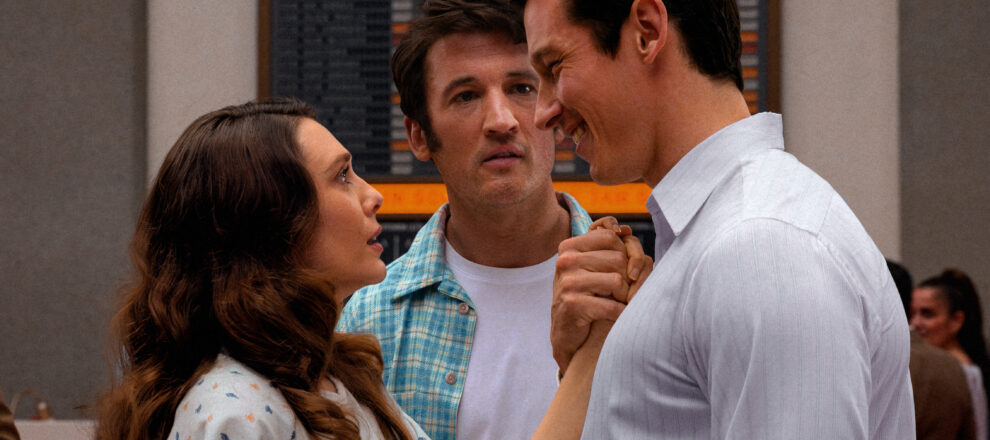
The premise is bold, almost audacious. When Larry (Miles Teller) unexpectedly dies, he awakens in a brightly lit, slightly overworked bureaucratic way station for the recently deceased – a kind of metaphysical OR Tambo arrivals hall, except with better lighting and an alarming amount of paperwork. Here, he learns from his assigned Afterlife Coordinator (Da’Vine Joy Randolph) that he has just one week to confront the ultimate dilemma: where, and with whom, to spend eternity. But when Joan arrives soon after him, she finds her first love Luke (Callum Turner) has been waiting in limbo for 67 years to be with her. She is faced with an impossible choice between the man she spent her life with and the man who promises her the life she could’ve lived.
And so, ETERNITY drops Joan into a conflict with no villain and no right answer. It’s the rare love triangle in which everyone is sympathetic, everyone is good, and everyone is trying their best to navigate a situation so awkward it borders on existential slapstick.
This is where the film’s originality thrives: not in the spectacle of the afterlife, but in the deeply human messiness of its emotional dilemma.
Awkwardness As Emotional Truth
Romances often pretend that love is smooth, effortless, intuitive. ETERNITY knows better.
Its most memorable moments are not declarations of love but moments of exquisite, toe-curling awkwardness:
- Joan trying to reassure Larry that she is, indeed, thrilled to see him – while Luke waits politely three feet away.
- Luke attempting small talk with the husband who replaced him, offering a handshake that is both overly formal and painfully longing.
- Larry awkwardly bragging about “67 years of marriage” while Luke quietly notes that he and Joan were married first.
- Joan trying to attend her Afterlife Coordinator’s informational seminar on “Choosing Your Eternity Zone” while both men sit on either side of her like deeply invested bookends.
This isn’t awkwardness played for slapstick alone. It’s the awkwardness of being known – fully, painfully, beautifully known – by two different people who loved different versions of you.
And in these moments, ETERNITY becomes something rare: a film that trusts awkwardness as a vessel for truth. Because real love is awkward. Real grief is awkward. Real choices – the ones that define us – are often made in the most uncomfortable, uncertain spaces.
A Bureaucratic Afterlife That Makes Love Complicated, Not Easy
The film’s afterlife is not all clouds and harps. It’s a brightly lit, slightly whimsical processing centre run by “Afterlife Coordinators” – civil servants of eternity whose job is to guide souls toward one of several themed living zones. You can spend forever in Casino World. Or Paris Land. Or on an endless spring afternoon with perfect weather and even more perfect lighting.
The catch? Once you choose, it’s forever.
Which means Joan’s “impossible choice” isn’t just between two men – it’s between two eternities.
Does she choose perpetual comfort with Larry, the man who held her hand through cancer scares, through raising kids, through the exhaustion and intimacy of real, ordinary, everyday commitment?
Or does she choose Luke, the first love who died young, the life she never got to live, the version of herself that froze in amber at twenty-four?
Most romance films are about gaining love. ETERNITY is about the terror of choosing it.
This is what makes the emotional stakes so profound. Joan isn’t choosing between passion and stability. She’s choosing between memory and possibility. Between the person she became and the person she might have been.
It’s a love story constructed not around desire but around identity.
Becoming Someone Who Can Choose
The brilliance of ETERNITY is that Joan’s journey is not about which man she loves. The film treats her feelings for both Larry and Luke as real, valid, and multi-layered. Love is not in question. Her capacity to decide is.
This subtle reframing is what sets ETERNITY apart. The film is ultimately about a woman forced to confront the truth that the hardest part of love has never been feeling it – it’s choosing it. Actively. Consciously. Without the inertia of habit, or the fantasy of nostalgia, or the weight of expectation.
And so, the love triangle becomes a mirror.
Larry represents the life she lived.
Luke represents the life she lost.
Joan represents the life she now must define, fully aware that the next decision will last, quite literally, forever.
This is the film’s quiet genius: the love story happens internally. Joan is not torn between two men. She is torn between two selves.
Humour With a Pulse
Despite its existential stakes, ETERNITY is frequently laugh-out-loud funny. The bureaucratic afterlife is a treasure trove of deadpan comedy:
The “Eternity Zone” brochures that look like holiday pamphlets from 1992.
The seminar called “Forever: A Beginner’s Guide.”
The fact that souls arrive at their happiest physical age, leading to rooms full of oddly specific twenties and thirties… and a lot of 10-year-old boys!
The Afterlife Coordinators who recite cosmic policy with the energy of someone explaining how to reset a Wi-Fi router.
This humour isn’t a distraction. It’s a release valve. The comedy keeps the film buoyant, preventing the central dilemma from suffocating under its own weight. More importantly, it makes the characters feel more real – because grief, love, confusion, and laughter often coexist.
In blending humour with heartbreak, the film achieves something quietly revolutionary: it treats the afterlife not as paradise or punishment, but as a deeply human place where unresolved emotions follow you, clipboards, and all.
The Most Original Love Story of the Year
So, is ETERNITY truly the most original love story of the year? Absolutely – but not because of its high-concept afterlife, or its comedic tone, or its cleverly constructed eternity zones.
It’s original because it is honest.
It acknowledges that love is complicated. That we are multiple versions of ourselves across a lifetime. That first love and lifelong love are not mutually exclusive. That the heart is capable of loyalty and longing at the same time. And that choosing someone – truly choosing – requires a level of clarity that most of us spend decades trying to develop.
ETERNITY is not about which man Joan picks.
It is about the woman she must become in order to pick at all.
It’s a love story that isn’t about love until suddenly, quietly, devastatingly, it is. And by then, it has already done something extraordinary: it has reminded us that love isn’t fate, or passion, or default. It’s choice. Inconvenient, awkward, terrifying choice.
Which makes it, perhaps, the most human love story we’ve had in years.