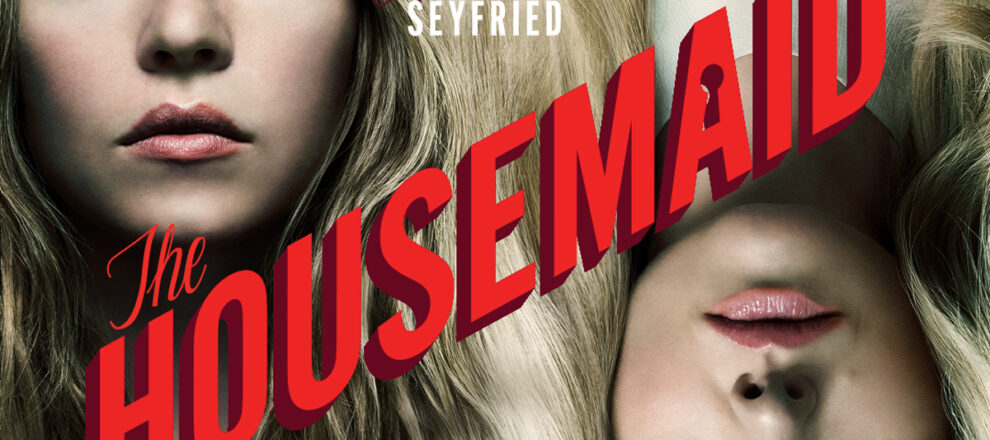
by Ophelia Anderson
When Freida McFadden self-published The Housemaid in 2022, she had no idea she was about to ignite a global phenomenon. A brain-injury physician turned novelist, McFadden had already built a devoted following for her domestic thrillers – but The Housemaid was different. It spread like wildfire. Word-of-mouth exploded on BookTok. Book clubs devoured it. Readers called it “an addiction,” “a fever dream,” and “a thriller with no brakes.” Soon it was topping bestseller lists around the world.
Now, with over 3.5 million copies sold and 130+ weeks on The New York Times list, The Housemaid makes its leap to the big screen in a film that delivers all the jaw-dropping twists fans love – without giving a single secret away.
Director Paul Feig, known for Bridesmaids, A Simple Favor, and Last Christmas, was an unexpected but inspired choice. “I always saw The Housemaid as a Nancy Meyers movie gone horribly wrong,” Feig says. “It’s elegant, stylish, sunlit – but also terrifying. I wanted to pull that string as far as I could without breaking it.”
The result is a psychological thriller wrapped in luxurious domestic fantasy: pristine cream interiors, immaculate décor, popping red accents, gossip-filled neighbourhoods, and a mansion that feels like a character all its own. But make no mistake – this beauty is skin deep. “Everything in that house is immaculate and symmetrical,” producer Todd Lieberman says, “until the story begins to dismantle it.”
And dismantle it does.
Why this book was destined for adaptation
McFadden wrote The Housemaid while practising medicine full-time, crafting tense domestic mysteries between hospital shifts. “I’m fascinated by traps,” she says. “We’ve all been stuck in situations we can’t easily escape.” That theme – being lured into a beautiful nightmare – became the backbone of the novel.
Producers Lieberman and Carly Elter recognised its cinematic potential early. “It had all the ingredients,” Elter says. “High tension, layered characters, surprising reversals, and a setting that begs to be visualised.”
Screenwriter Rebecca Sonnenshine (The Boys, Archive 81) understood that the key to the adaptation was capturing the book’s addictive rhythm. “Every time you think you know what’s happening, the story flips,” she says. “But it’s not just the twists – it’s the psychology.”
She built the screenplay around the vertical layout of the Winchester mansion: Millie’s cramped attic room above, Andrew’s plush man cave below, and Nina trying to hold the perfect façade together on the main floor. “The house is a power map,” Sonnenshine explains. “Who’s up, who’s down, who’s hiding something – it’s all in the architecture.”
The triangle that drives the tension
At the story’s centre are three powerhouse performances: Sydney Sweeney as Millie Calloway, Amanda Seyfried as Nina Winchester, and Brandon Sklenar as Andrew Winchester.
“Each of them plays the victim, villain, hero, and bystander at different points,” Elter says. “You’re constantly shifting alliances.”
Sweeney, already a fan of the novel, came aboard as both star and executive producer. “The twists never stop,” she says. “Millie is bruised but unbroken. She’s a fighter.”
Seyfried, meanwhile, seized the chance to play one of the most unpredictable characters of her career. “Nina is fragile and fierce at the same time,” she says. “I’ve never played anyone quite like her.”
Brandon Sklenar rounds out the triad as Andrew; the charming patriarch whose every smile hides something. “Andrew appears to be living a perfect Instagram version of life,” Sonnenshine notes. “But perfection is always suspicious.”
A thriller where daylight becomes the enemy
Unlike most psychological thrillers, The Housemaid doesn’t hide its tension in shadows.
Cinematographer John Schwartzman (Oscar nominee for Seabiscuit) floods the Winchester home with sunlight – only to make the brightness feel claustrophobic.
“There’s nothing scarier than terrible things happening in broad daylight,” Feig says. “There’s nowhere to hide.”
The production design echoes the book’s themes: immaculate surfaces masking ugly truths, perfect symmetry concealing off-kilter secrets. “Even the artwork has disturbing hints hidden inside,” Lieberman says.
The dollhouse – Cece Winchester’s eerie miniature replica of the home – is an especially chilling invention. “It becomes a psychological roadmap,” Feig explains. “It tells you something is very wrong long before the characters do.”
Balancing darkness with entertainment
Feig, a director known for blending genres, didn’t want the film to become overly bleak. “I love thrillers, but sometimes they take themselves too seriously,” he says. “This story needed to be scary and fun.”
Sonnenshine agrees. “You’ll gasp, you’ll groan, you’ll laugh because you can’t believe they just did that.”
That balance – darkness layered with wicked humour – is what made the book a sensation. And it’s what Feig leans into on screen.
What makes this adaptation stand out
- It honours the book’s big shocks
The filmmakers are cryptic about changes but promise the core reveals remain intact. “When I read the script, I got chills,” McFadden says. “Some changes were so good, I wished I had put them in the book.” - It deepens the characters
The film expands motivations, especially Nina’s and Andrew’s, adding backstory without spoiling the mystery. - It embraces beauty as a weapon
From costume design to camera angles, the aesthetic becomes part of the storytelling: the more perfect everything looks, the more disturbed you feel. - It’s engineered for a communal gasp
“This is a big-screen movie,” Feig says. “You want to hear the audience react together.”
Why readers and newcomers will both be obsessed
If you loved the book, the film will feel like rediscovering a favourite roller coaster from a new angle. If you haven’t read it, the story’s slippery social dynamics, seductive surfaces, and gasp-worthy reveals will pull you into the trap Millie walks into.
As McFadden puts it: “It’s a story about the danger of believing what you think you see. Nothing in that house is what it seems.”
And when those immaculate doors finally swing open on December 19, audiences will learn – just like Millie – that beauty can be a warning sign, and that the darkest secrets thrive in the brightest rooms.